How to write a critical reflection on one decision
Follow one group decision from a descriptive first draft to a critical reflection. Use a course concept, test another explanation and plan a change you can observe.
Your group agrees on Tuesday. Later you discover the person who had already left has a shift that evening. A descriptive paragraph can report the clash in two lines. A critical reflection has a harder question to answer: what made you treat the silence in the room as agreement? Follow that decision through two drafts, then use the same test on a moment from your own course or placement.
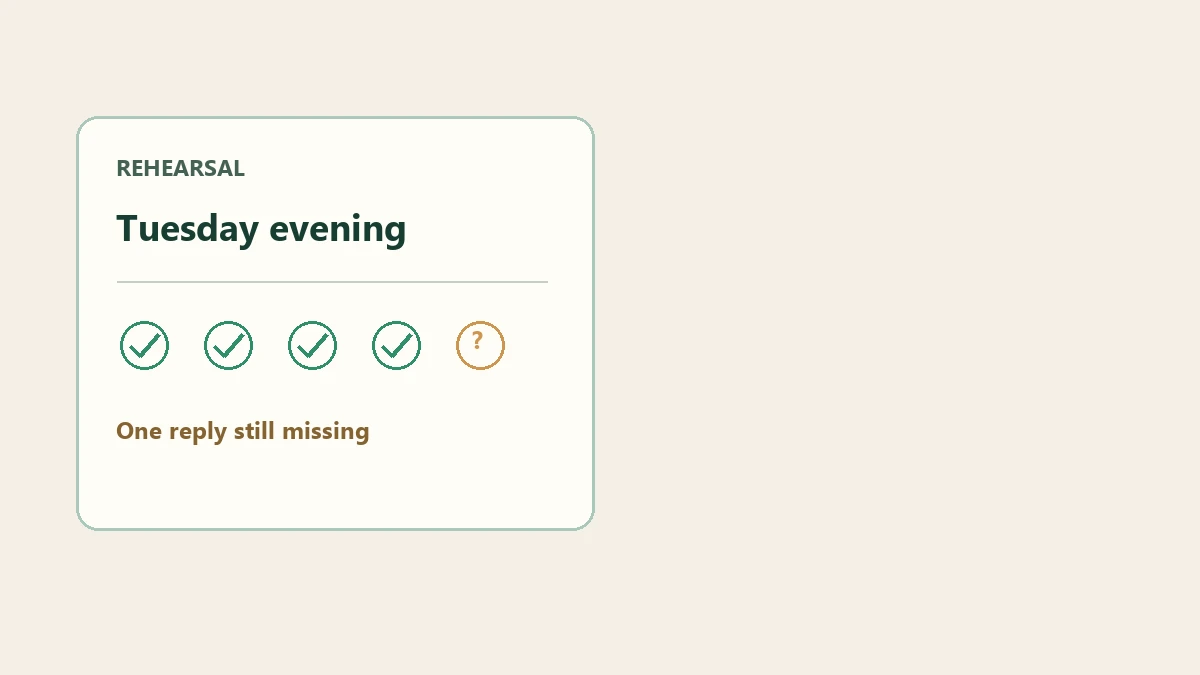
Take a fictional seminar group choosing a time to rehearse. Four members are present. One member has gone to work. When nobody objects to Tuesday evening, the chair enters Tuesday in the group calendar. Later, the absent member says they have a shift then. If you were the chair, the useful moment to examine would be when you entered the date. That is the decision you can account for from the inside.
Gather the pieces you actually have. The calendar entry records the date. Your notes may record who was there. Only you can explain what you took the silence to mean. Unless a classmate tells you why they stayed quiet, their reason remains open. That boundary matters when you write about peers or a placement. Leave out details that could identify someone when they add nothing to the analysis.
Our group had a problem with communication. I organized a rehearsal for Tuesday, but one member could not attend. I learned to listen to everyone and will communicate better in future.
You can follow the events, yet two questions remain. What did the chair believe they had settled? What will “communicate better” look like next time? An account of an awkward evening becomes a reflection when the writer makes the original assumption available for examination.
Look for the sentence in your own draft that another person in the room could not have written. “I wanted to leave the meeting with a firm booking because I was responsible for the room” is one. It introduces a real tension. The chair had a reason to move quickly, and the group still needed a way to hear from someone who was away.
For this example, suppose the assigned reading distinguishes an opportunity to speak from an opportunity to participate in a decision. The chair heard no objections from the people in the room. The absent member had no opportunity to object. That distinction changes what the silence can support.
I entered Tuesday as a confirmed booking because nobody at the meeting objected. I wanted to reserve the room while it was available, and I treated that practical deadline as a reason to settle everyone’s availability. The distinction in our reading between speaking and participating helps me see the gap. I had asked for objections in a room that one member had already left. I could reasonably say that Tuesday worked for those present. I had no basis for recording it as the group’s decision.
In an actual paper, name and cite the assigned author where the idea enters your analysis. The passage above uses an invented seminar prompt. Substituting a real quotation is useful only if you can explain which detail in your account it illuminates. If your rubric requires a second perspective, consider what the room coordinator needed: a reservation deadline can be genuine even when the way you communicate the booking needs to change.

Imagine the absent member had already sent you a message confirming Tuesday. Recording the booking would then rest on evidence you could point to. Without that message, Tuesday was only a proposal. Put the two versions side by side in your notes. Which fact changes your judgement? That fact is often worth more space in the reflection than a full chronology of the meeting.
“I will ask everyone” sounds better than the first draft, but it leaves the same difficulty if someone is away again. A more useful ending would read:
Next time I’ll reserve the room provisionally and send the group the time when the booking becomes final. I’ll record replies beside each proposed slot. If a member has not replied by the deadline, I’ll tell the group whose availability is still unknown before we confirm.
That action fits the original constraint. It also supplies a test for a later reflection: did the next group record which times were confirmed and which remained uncertain? You need no invented happy ending. If you have already tried the change, report what you observed and distinguish it from what you expected.
For a placement reflection, choose a decision within your own role and follow the placement’s confidentiality instructions. For a response to a reading, the decision may be intellectual: which passage made you revise an interpretation, and what did you initially overlook? In a short entry, compress the scene to one or two sentences and use the space for the change in your thinking. A marker asking for a named reflective model may expect its stages to be visible. Follow that prompt before borrowing this structure.
The University of Waterloo’s critical reflection guide distinguishes exploring an experience from organizing the resulting argument. Try its questions first in rough notes. Then read just the opening decision and the closing action in your draft. If the ending could fit any story about teamwork, return to the specific moment when you put Tuesday in the calendar.
It examines the reasoning behind an action. Identify what you assumed at the time, put that assumption beside evidence or a course idea, and explain how the comparison changes your reading of the event.
First person helps distinguish what you decided from what you observed others doing. Follow your course instructions and support your interpretation with specific details rather than guessing another person’s motives.
Describe a change you can actually make and how you would check it. In the rehearsal example, the chair could mark a booking as provisional and record whose availability was confirmed. You can propose that test before knowing its outcome.